
What happens when the most deflationary technology in human history collides with the world’s most indebted country?
We will find out soon, and I think most people will be blindsided.
Consider this.
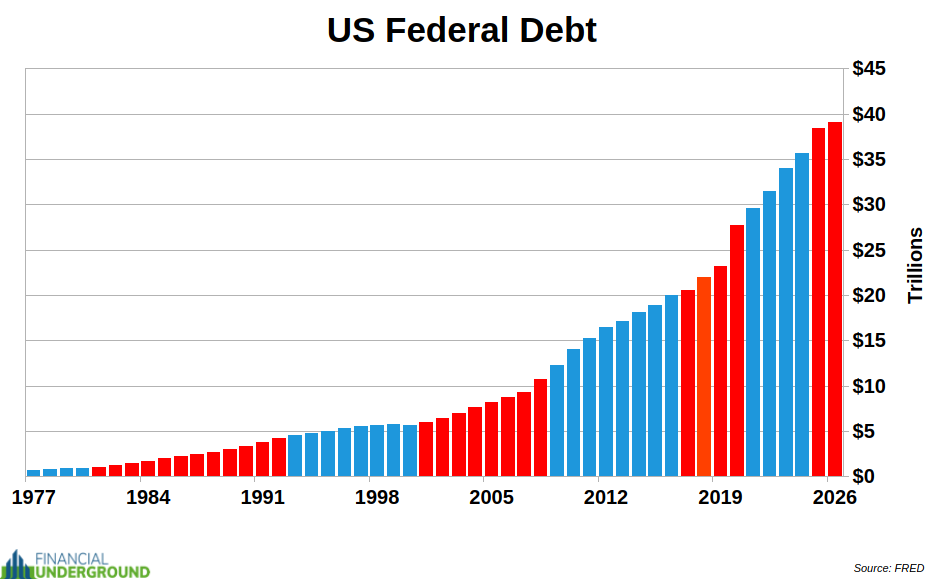
The US federal government has the biggest debt in the history of the world. And it’s continuing to grow at a rapid, unstoppable pace because Washington cannot stop spending.
Among the biggest expenditures for the US government are so-called entitlements like Social Security and Medicare.
It’s unlikely any politician will cut entitlements. On the contrary, I expect them to continue growing.
That’s because tens of millions of Baby Boomers—about 22% of the population—will enter retirement in the coming years. Cutting Social Security and Medicare is a sure way to lose an election.
The interest on the federal debt is already the second-largest federal expenditure. In a matter of months, it’s set to exceed Social Security and become the biggest expenditure.
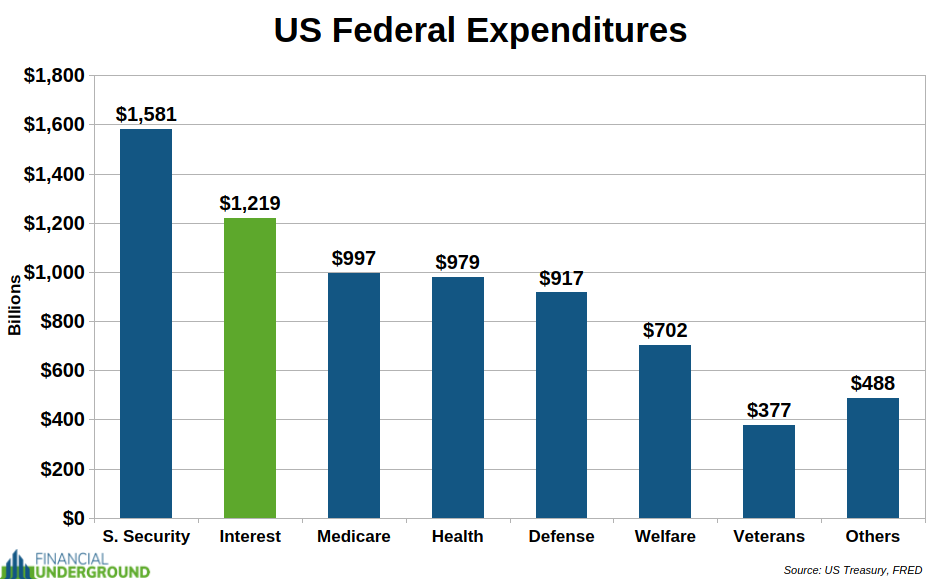
With the most precarious geopolitical situation since World War 2, National Defense—another large expenditure—is unlikely to be cut. Instead, defense spending is all but certain to increase. President Trump has proposed increasing it from $917 billion to $1.5 trillion. The ongoing war with Iran guarantees military spending has nowhere to go but up, way up.
Different types of healthcare and welfare programs also make up a considerable part of the federal budget and are unlikely to be cut.
In short, efforts to reduce expenditures will be meaningless unless it becomes politically acceptable to make chainsaw-like cuts to entitlements, national defense, and welfare while reducing the national debt to lower the interest cost.
In other words, the US would need a leader who—at a minimum—returns the federal government to a limited Constitutional Republic, closes the 800 military bases abroad, ends entitlements, kills the welfare state, and repays a large portion of the national debt.
However, that’s a completely unrealistic fantasy. It would be foolish to bet on that happening.
Here’s the bottom line.
The government cannot even slow the spending growth rate, let alone cut it.
Expenditures have nowhere to go but up—way up.
So how are they going to finance all this unstoppable spending?
When faced with a choice, politicians always choose the most expedient option.
In this case, that means issuing more debt rather than making tough budget decisions or explicitly defaulting.
Consider the recurring debt ceiling farce in the US Congress, which has been raised over 100 times since 1944.
In any case, don’t count on increased tax revenue to offset these increases in federal expenditures.
Even if tax rates went to 100%, it still wouldn’t be enough to stop the debt from growing.
According to Forbes, there are around 902 billionaires in the US with a combined net worth of about $6.8 trillion.
The US federal government spent around $7 trillion in FY 2025, and will almost certainly spend a lot more in FY 2026 and beyond.
Even if the US government confiscated 100% of billionaire assets through a wealth tax, it wouldn’t cover even a single year of current federal spending.
And even after confiscating all billionaire wealth, the US government would still have to borrow more than $200 billion to cover FY 2025 spending.
Here’s the bottom line: increasing taxes, even to extreme levels, isn’t going to change the trajectory of this unstoppable trend—even slightly.
The truth is, no matter what happens, the deficits will not stop growing, nor will the debt needed to finance them.
The growth rate is not even going to slow down. It’s going to increase.
That means interest expense on the federal debt will continue exploding higher.
The federal debt’s interest cost is already higher than the defense budget. It’s on track to exceed Social Security in the coming months and become the biggest in the federal budget.
In short, the skyrocketing interest expense has become an urgent threat to the US government’s solvency.
How AI Accelerates the Debt Spiral
If AI is going to wipe out a large portion of white-collar jobs, that represents a meaningful amount of tax revenue the US government will lose. That means it will need to issue even more debt to cover its growing expenses, compounding the debt spiral it is now clearly in.
Annualized interest on the federal debt exceeds $1.2 trillion and is surging higher. That means more than 23% of federal tax revenue is going just to service the interest on the existing debt. That number is all but certain to rise, further squeezing the US government’s options.
Further, what will happen to the mortgages, car loans, credit card debt, and student loans of the white-collar workers AI replaces?
I expect many of them will become delinquent or default, and that will cause major losses for the financial institutions that underwrote the debt. These financial stocks can be expected to drop once the market realizes many of the loans they made are not going to be repaid.
And when financial stocks start to fall, it will affect retirement accounts and other portfolios invested in them.
It is not hard to imagine how AI could collapse this financial house of cards.
This is why the Fed and other central banks are so concerned about “deflation” in general, and AI in particular.
The defining feature of the financial and monetary system is that it requires ever-increasing debt and currency debasement to sustain itself. Inflation is a structural requirement to keep the system running.
That is why you see nonsensical things like the Fed’s totally arbitrary 2% inflation target. Why not target 0%? The obvious, unspoken answer is that the system could not tolerate it.
In short, deflation is an existential threat to a debt-ridden economy and fiat currency system.
If even sub-2% inflation—as measured by rigged CPI statistics—is enough to scare central bankers (really central planners), imagine what the most deflationary technology in human history could do. It could hit this overleveraged, overfinancialized system like a sledgehammer.
I think there is no doubt AI has the potential to trigger a debt crisis that could collapse the whole system.
So, do you think the Fed will sit back, do nothing, and watch the whole house of cards come crashing down, or will it create an enormous amount of inflation in a desperate attempt to hold the system together?
I think it is clear they will choose the latter.
It is important to clarify something.
While there is a limit to the amount of deflation that can result from increased productivity and efficiency, there is no limit to the amount of inflation central banks can create.
So inflation will win at the end of the day.
In short, fiat inflates faster than tech can lower costs.
The question is not whether they will print. I think it is clear they will. The question is when will they print, and which assets will win when that happens?
That is the real question investors need to answer now.
Because once the next wave of money printing begins, the people who wait for an official warning will almost certainly be too late.
The good news is that there are practical steps you can take today to better understand what is coming—and position yourself before the next phase of this crisis becomes obvious to everyone.
That’s why we’ve put together a free PDF report showing the key risks ahead and the top three strategies you should consider right now.