
Kind of scary, isn’t it?
But wait, there is more, as they say in cheap commercials selling steak knives.
Have you ever heard of super phosphate? Oh, the mere mention of it reminds me of the good old days on the farm in New Zealand all those years ago. Spreading fertiliser with an old Bedford truck. You never forget the distinctive smell of “super,” nor 2-4-D, 2-4-5-T, or Paraquat for that matter.
Yes, 2-4-D and 2-4-5-T combined was essentially Agent Orange — that horrid defoliant used in Vietnam.
Super phosphate is the backbone of fertilisers used on farms.
Superphosphate and nitrogen fertilisers serve distinct, complementary roles: superphosphate (P, S, Ca) boosts root development, legume growth, and long-term soil fertility without altering pH. Nitrogen (N) — e.g., urea — drives rapid, leafy vegetative growth, stem development, and overall plant greenness.
In essence, nitrogen makes things grow fast… gives plants a quick growing boost.
However, if the soil is not fertile (lacks nutrients) it won’t grow. So you need to have applied super first to give plants their nutrient base. Then, just prior to harvesting, farmers will apply nitrogen to give plants a quick growing boost.
Super phosphate is made by reacting finely ground phosphate rock with sulphuric acid. Sulphuric acid comes from sulphur (via the Contact Process).
And for those geniuses out there who studied agricultural economics… yes, there is triple super phosphate that is made with phosphoric acid instead of sulphuric acid, BUT phosphoric acid is also derived from sulphur.
In other words, no sulphur means no phosphate-based fertiliser.
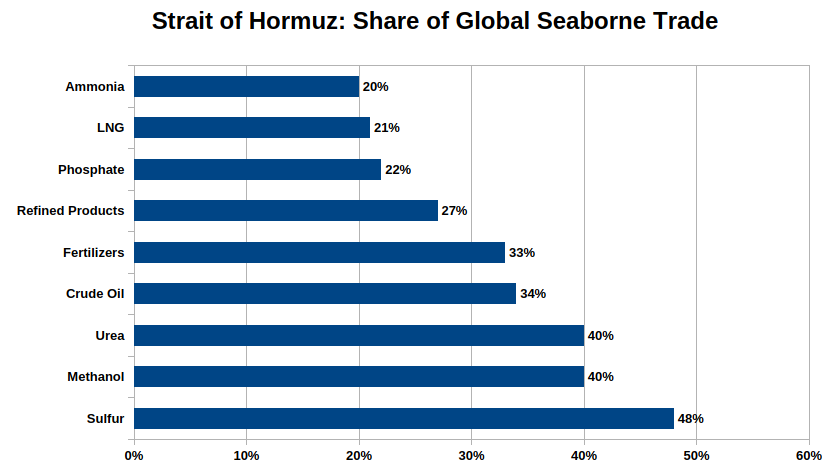
But wait… it gets worse! Some 15% of the world’s phosphate rock is produced by Middle Eastern countries and must pass through the Strait of Hormuz.
By now you have probably figured out where this line of thinking is going…
The blocking of the Strait is going to be way more devastating to farming/crop production than what the vast majority is being led to believe.
A global food crisis… and when the masses go hungry!
The problem is that this will all be a delayed response. Folks won’t see the results of this show up until year-end.
Perhaps one should be taking a closer look at fertiliser producers… or at least the producers of the chemicals used to produce fertiliser who don’t depend on feedstock which passes through the Strait of Hormuz.
By now you are probably getting a “better than good” understanding that the closing of the Strait of Hormuz is way bigger than restriction of oil and gas.
Have you ever woken up from a nightmare only to be so relieved that it was just your imagination and that it wasn’t reality?
Well, what if you had 60% of your assets in the S&P 500 (essentially the Mag7 and relatives) and the other 40% in long-dated bonds? What would be the nightmare that you hope to hell is just a dream and not reality? One word: inflation. You don’t want to own highly valued growth stocks or long-dated bonds under conditions of rising inflation.
We remind readers just how crowded indexing as an investment strategy has become. We also remind readers that most portfolios that aren’t indexed are quasi-indexed (closet index-hugging). We all know what happens to crowded trades!
Bitching about the rising cost of gasoline/diesel will be the least of folks’ worries over the coming months as the direct and indirect effects of the Iran “conflict” take hold.
Editor’s note: The risks now building beneath the surface are far larger than most investors realize. Our new free PDF report lays out the economic, political, and cultural fault lines taking shape right now, what they could mean for your money and personal freedom, and how to think about protecting yourself before the crowd catches on. Get your free copy here.