
At this point, the whole Iran war comes down to one thing: who controls the Strait of Hormuz.
The Strait of Hormuz is a narrow strip of water that links the Persian Gulf to the rest of the world.
It’s the world’s single-most important energy corridor, and there’s no alternative route.
Before the current war broke out, roughly 20 million barrels of oil per day passed through the Strait, according to the US Energy Information Administration. That is about 20% of global oil production. Another 20% of global LNG exports also moved through it each day.
It is difficult to overstate how important Hormuz is to the global economy. If it were disrupted for a prolonged period, it could cause an energy crisis and a global economic depression.
And that is exactly why Hormuz matters so much in this war.
Thanks to its commanding geography, missile reach, naval mines, drones, and decades of preparation for unconventional warfare, Iran can shut the Strait down—or at least make it too dangerous for normal commerce to continue.
That’s why the US Navy doesn’t even dare to venture too close and hasn’t been anywhere near the Persian Gulf since the war started.
There’s not much anyone can do about Iran’s control over the Strait short of a large-scale ground invasion and occupation of the country, which would itself be an extremely risky and uncertain undertaking.
Hormuz is Iran’s geopolitical trump card, and it is now being played.
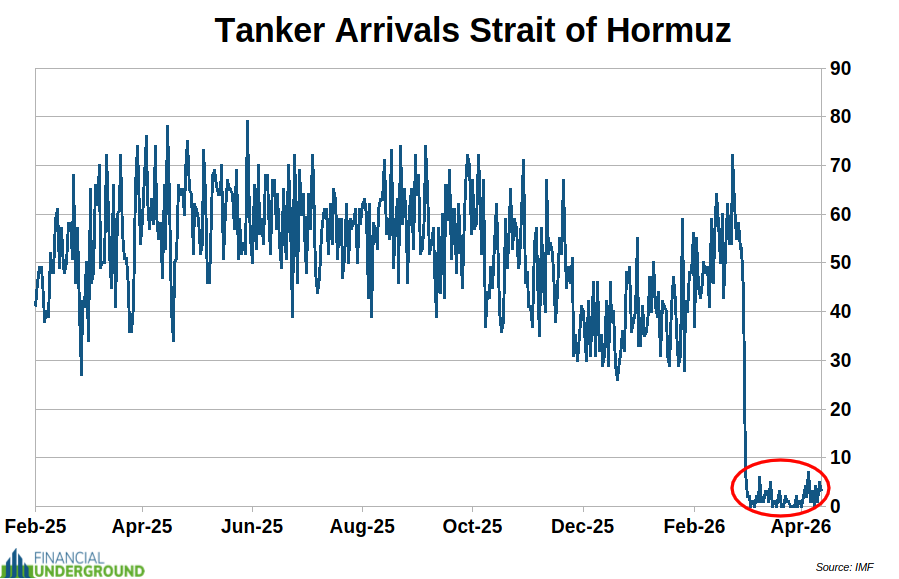
If you wanted to distill it down to a simple scoreboard of who is winning and who is losing the war, there is probably nothing better than the chart below, which shows oil tanker arrivals through the Strait of Hormuz.
Until the Strait of Hormuz is fully reopened to the US and its allies at prewar levels, Washington cannot credibly claim it is winning the war.
Before the war, an average of about 53 oil tankers entered the Strait each day. Now, there are perhaps a couple at best.
Worse still, Iran could target oil infrastructure across the Persian Gulf, destroying production facilities in Saudi Arabia, the United Arab Emirates, Qatar, Bahrain, and Kuwait. Even if the Strait reopened, there could be nothing left to export.
In short, Iran holds a knife to the throat of the global economy.
In my view, the real, unambiguous metric of “who won?” will be determined by who controls the Strait of Hormuz.
If, after the war, Iran can exert control over Hormuz, and thereby hold the global economy hostage, I believe the Middle East and much of the rest of the world will perceive the US as having lost. That would have an enormous effect on the US’s credibility as a superpower.
That’s why the potential battle for Hormuz will be the decisive moment of the war.
However, taking control of Hormuz away from Iran would not be easy. Securing the Strait from Iranian missiles, drones, and other attacks would likely require a ground invasion to control a mountainous coastal area roughly the size of South Vietnam—terrain the Iranians have had decades to prepare to defend.
And securing that beachhead from Iranian fire deeper in the interior would require an even deeper invasion. Iran has strategic depth. In all likelihood, for the US to seize Hormuz—and successfully hold it—would require a full-scale invasion of Iran and the overthrow of the current government.
The issue is not whether the US can bomb targets, sink boats, or inflict damage—it most certainly can. The issue is whether Washington can, by military force, impose a durable political outcome at the key maritime bottleneck that matters most for global energy.
The US strategy is now centered on reopening the Strait of Hormuz, restoring the same situation that existed before the war began. If, nearly two months into a war you initiated, your objective is simply to get back to where things were before it started, it’s hard to call that a win. It’s a sign of strategic incoherence and incompetence.
Here’s the bottom line.
What happens at the Strait of Hormuz will not stay there.
It will shape energy prices, financial markets, geopolitical power, and the economic outlook for people far beyond the Middle East.
If you want a clearer understanding of the risks now unfolding, what they could mean for your money and personal freedom, and the key steps you can take to prepare, you can get my free special analysis here.